Friday, February 28, 2025

Camping Construction Cables: The Taut Line Hitch

 The first knot in this series that I'd really say everyone needs to know, the Taut Line Hitch works like one of those adjustable buckle-straps they put on packs and binoculars and stuff. One end has a loop, the more rope you put into the loop, the "shorter" the overall rope will be. This is most famously used for tightening the guy lines on tents, but you can also use it for things like hanging a clothesline or protecting the Hubble Telescope

Lassoing is not a good use for this knot.
Thanks, chair!

I think the version I tie is technically a midshipman's hitch, but it works more or less the same (with minor trade offs in security, slideability, etc.) outside of some edge cases.

To tie: Make a loop. Put the end of the rope through the loop at least twice (more will help if rope is wet, slippery, etc.) Then make a second loop on the rope "outside" the main one.

These are so much easier to follow than the other sites'.
Yay, theknotmanual.com

Quick and easy to tie, I think the taut-line is the knot that I've forgotten the least over the years. 5/5, an easy one to add to the challenge.




Thursday, February 27, 2025

Cloves Cinch and Cleave (The Clove Hitch)

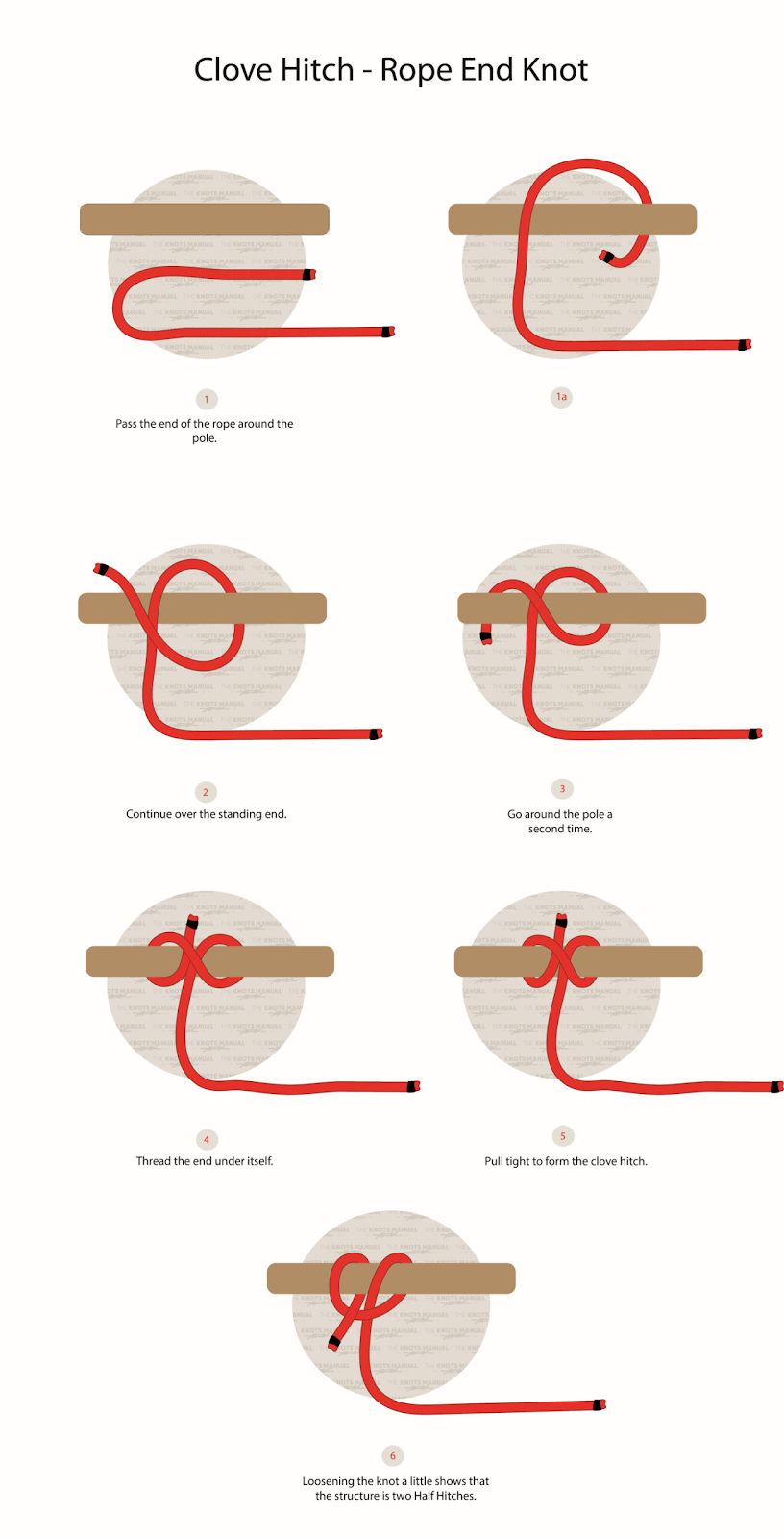
 The clove hitch is used mostly for one of two things. First, to tie in the middle of a length of rope to attach something. The fact that it's somewhat adjustable is useful for this (say you want more or less slack on the line holding your tool bag). Second, as a start/end for lashings which is an arrangement of rope to hold spars, scaffolding, etc. together.

X marks the hitch
Possibly excessive photo editing.

It's a pretty simple knot: Wrap your rope around whatever you're tying to. Cross the end over the rope (it makes an X). Then go around again under the X.

dunnanana naaah na naaa
theknotsmanual.com

I don't know why I struggled with it so much the other day and rated it too difficult. I think I was overthinking it, or maybe looked at a bad set of instructions to brush up. 5/5, quick, easy, and hard to mess up.

Wednesday, February 26, 2025

Combining Coils Constructively: The Square Knot

 The first knot on dad's list is the square knot, AKA the reef knot. Popular and easy to tie, this is often the first knot taught in Scouting, camping groups, etc. The shoe-lace knot is considered a variant, and the first "formal" knot a lot of people learn.

Hand holding a square knot
HAND REVEAL!

DON'T use the square knot to attach two different ropes to each other (that's what a sheet bend is for), it's not stable (especially if the ropes are different sizes, slippery, etc.) Also, be careful not to accidentally tie a granny knot, which tends to either untie itself or over tighten and jam up. 

A hand holding a granny knot
Bad Granny


Basically, it's a quick and easy way to attach two ends of the same rope together. Historically, it was used to "reef" (partially roll up) sails. Today, it's occasionally used on packages and the like.

The steps for tying the knot  can easily be remembered as "left over right, around and through; right over left, around and through." It's important to note that right and left "change" (which is how you avoid the granny knot). A lot of people over think this and try to remember the original left, and mess it up.


How to tie a square knot
credit: theknotsmanual.com

Not the most useful knot in the world, but fine for light work and easy to tie. The square knot is a 5/5 on my knowledge scale. I can tie it quickly and reliably, and won't need to practice it much for the minute challenge.

Tuesday, February 25, 2025

Classic Cordage Combinations 1: Introduction

 This blog is mostly here for me. It's a reading journal, more or less. But, I do confess that seeing those vie numbers (assuming any of you are real and not just bots) drop off makes me kind of sad. Around this time every year, I have my students do a project where they set a goal, research it, try to do it, write about it, etc. I do something with them every year, and this morning I decided I wanted to try to relearn some of the knots I used to know as a teenager in the Boy Scouts. My dad did a challenge where we had to tie... some number (it was at least six, but he wasn't sure) of knots in a minute. I poked around a little online and found other knot challenges (as fast as 14 in 1 minute or as slow as 6 in 2), lists of knots everyone should know, etc. and the list he gave me seems fairly representative. So, between now and St. Paddy's day, I'll be practicing six knots, and trying to get to the point where I can tie them all in a row (correctly) in under a minute. The knife posts seemed pretty popular, and this seems kind of along the same vibe.

The six knots are:

1. Square (reef) knot

2. Two half hitches

3. Bowline (THE KING OF KNOTS!)

4. Clove hitch

5. Tuatline hitch

6. Timber hitch

I suspect the sheet bend was on his original list (he was a big fan of it, always used to say the square knot was useless once you learned it), but those are the six he gave me.

This image from Art of Manliness has almost the same list, but with a Figure-Eight added in:


7 knots you should know
7 knots every (wo)man should know

Today, I looked up and practiced (I hope) correctly tying all of them. On a scale of 1 to 5 (1, I can't tie this thing at all; 5, I can tie this well enough for a speed challenge) I rate them as follows:

Square: 5 

Two half: 2

Bowline: 2

Clove: 3

Tautline: 3

Timber: 1

I'll spend the next couple days talking about each knot, and go from there. 


HtRaB: Ch 7 X-Raying a Book

 More of the same, really. Kind of losing interest. Like I said last night, I feel like I'm reading a lot of the same stuff over and over again. More rules that (Adler admits) are basically restatements of other rules. He gives a terrible summary of The Odyssey, talks about how titles used to be longer (like a webnovel title or something now), and suggests outlining the constitution. Maybe I'll make that tomorrow's post. For tonight, I will be starting another subseries for a bit. I don't want to drop these (unless I drop the book entirely) since part of the point here is to collect my thoughts more than to be marketable or whatever.

Adler's Rules for Analytical Reading:

1. Classify

2. Summarize

3. Outline (not necessarily on paper, in your head can be ok)

4. Identify the problems the author is trying to solve/discuss.

Monday, February 24, 2025

HtRaB Ch 6 Pigeonholing A Book

 I get the feeling people don't love these (not that this was the world's most popular blog before, but the numbers really dropped off). Maybe I'll come up with some kind of filler while I finish this book until I dive into "actual" books again.

To be fair, I'm not the biggest fan of the last couple chapters either. They've been fairly repetitive (this one is mostly elaborating on doing the title/chapter preview thing) and over long (which is saying something when they're only like ten pages). I really liked the initial premise, "People need to be taught how to read at a higher level" but I think there's been maybe 15 pages of teaching in the 70 I've read (~20% is not a great ratio). Going to stick with it a bit longer, but I hope it picks up.

This chapter deals (besides repeating other parts) with classifying books. Fiction vs nonfiction, practical vs theoretical, etc. Maybe it's my creative writing major coming out, but I've always found trying to "pigeonhole" books as a wasteful endeavor. Most books will contain elements of several categories (which he does acknowledge, though he never really reconciles it with the rest of the chapter), and those categories are often poorly defined or unhelpful anyway. He sort of acknowledges this critique, but doesn't really respond effectively. He just makes an awkward metaphor to different teachers teaching different subjects differently.

Sunday, February 23, 2025

How To Read a Book Ch 5: How To Be a Demanding Reader

Active/demanding/whatever you want to call it requires several different skills to help you pay attention, understand the book, and interact with it. Marking (basically the same as the article I read earlier), asking questions, etc. He compares learning to read well to skiing or art. You need to learn a bunch of different rules/skills, practice them individually, and then learn how to use them automatically together.

It starts with a great line, "The rules for reading yourself to sleep are easier to follow than the rules for saying awake while reading." (Which involve not enough light.)

He lists four key questions:

1. What is the book about as a whole?

2. What is being said in detail, and how?

3. Is the book true, in whole or part?

4. What of it? 

This was a pretty overviewish chapter. Hopefully more detail later. 

Bacon's Essays 17 (Superstition)

 Bacon's Essays 17 (Superstition) Bonus:  Kinda lazy tonight. Summary:  Superstition is even worse than Atheism, since it leads to follo...